
Artistic inquiry
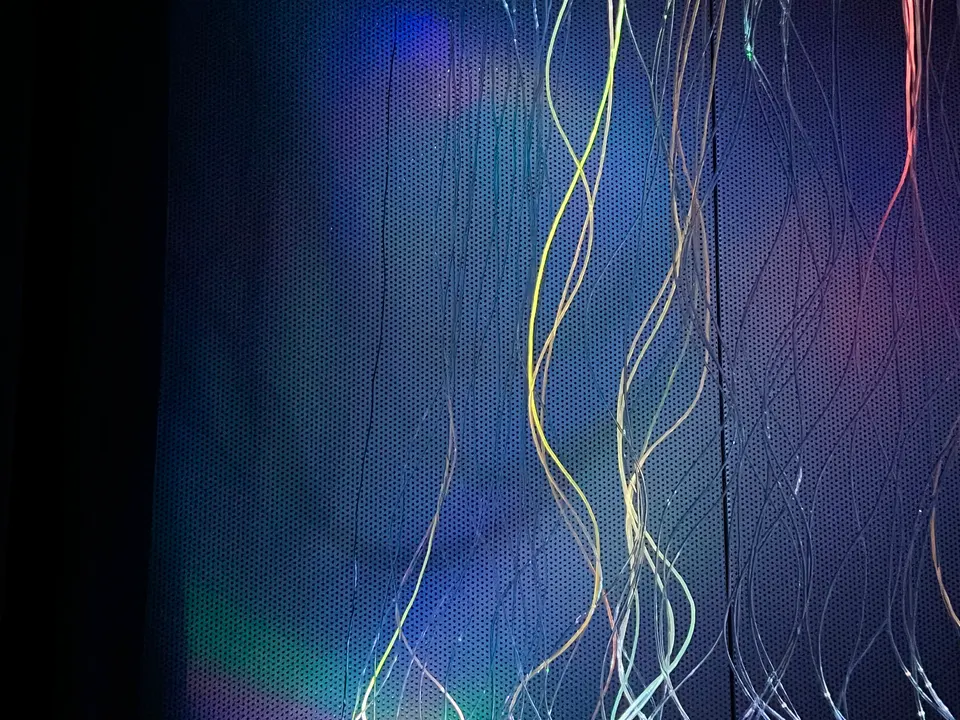
Light Wave expresses my perception of the artificial and the organic through programming, material exploration, and artistic judgment. I wanted the installation to feel like a floating screen that adds to the surrounding space. Colors sampled in NYC parks and demo audio that I intentionally selected and edited became part of that constructed environment.
How does something constructed acquire an organic presence through our encounter with it?
The floating screen gave this question a spatial form. Its frame, thread, and electronics are constructed materials; their combination produces a changing sensory experience. I was interested in the relationship between how the object is made and how it is perceived in the room.
Perception, existence, and meaning
I approach the work through an existential lens, asking how an encounter with something gives rise to meaning. In Light Wave, my choices in code, material, color, and sound give my perception a physical presence. Viewers bring their own associations to that presence.
The piece leaves room to consider what feels organic, what reveals its construction, and how both qualities can coexist in an experience. The floating screen offers a setting for those questions within the space people already occupy.
Demonstration
From material experiments to a light installation
The installation brings together an Arduino microcontroller, LED strips, translucent fabric thread, and a custom metal frame. Developing the piece meant working through the relationship between the thread’s visual qualities and the structure needed to hold it.
01 — Explore the thread as a medium
I experimented with different thread sizes and materials. The thread became a way to give light a physical form: its illuminated lines and overlaps created the organic visual expression of the piece. This made the material experiment central to the work’s appearance.
A useful way to evaluate these experiments is to consider both the visible light pattern and the behavior of the material. Thread size and material become artistic choices with practical consequences for connection, tension, and assembly.
02 — Choose a frame within the installation constraints
I considered different materials for the frame. With limited time and the weight of the suspended installation to consider, I eventually chose a lightweight metal frame. The decision brought the floating-screen idea into a construction I could realize within the project’s constraints.
The frame needed to support the stretched thread and define the surface of the screen. Its material choice was therefore connected to both the spatial idea and the practical demands of assembling a suspended object.
03 — Resolve the connection and tension
The most challenging part was connecting the thread to the LED strips while keeping it stable and stretched between the top and bottom of the metal frame. The connection to the light source and the way the thread was held had to be considered together.
This challenge made fabrication part of the artistic development. The frame, attachment, and thread form a single assembly: changes to one affect how the others can be arranged. The construction supports the luminous pattern that viewers encounter.
04 — Use programming as an artistic medium
With an Arduino microcontroller and LED strips, I used programming to shape the changing light patterns. The code and the physical thread work together: the programmed behavior becomes visible through the material, its arrangement, and its connections to the light source.
This is where technical development and artistic judgment meet. The experience depends on both the behavior I program and the form through which that behavior is seen.
05 — Bring color and sound into the experience
I used colors sampled in NYC parks and intentionally edited demo audio from free sound resources. Selecting and editing the audio was part of shaping the atmosphere of the installation, alongside the changing light and the physical thread.
This combination brings observed color and deliberately constructed sound into the same experience. Looking back, I would examine how the edited audio and changing light together influence the perceived relationship between the artificial and the organic.
Exhibition: the work in a shared space
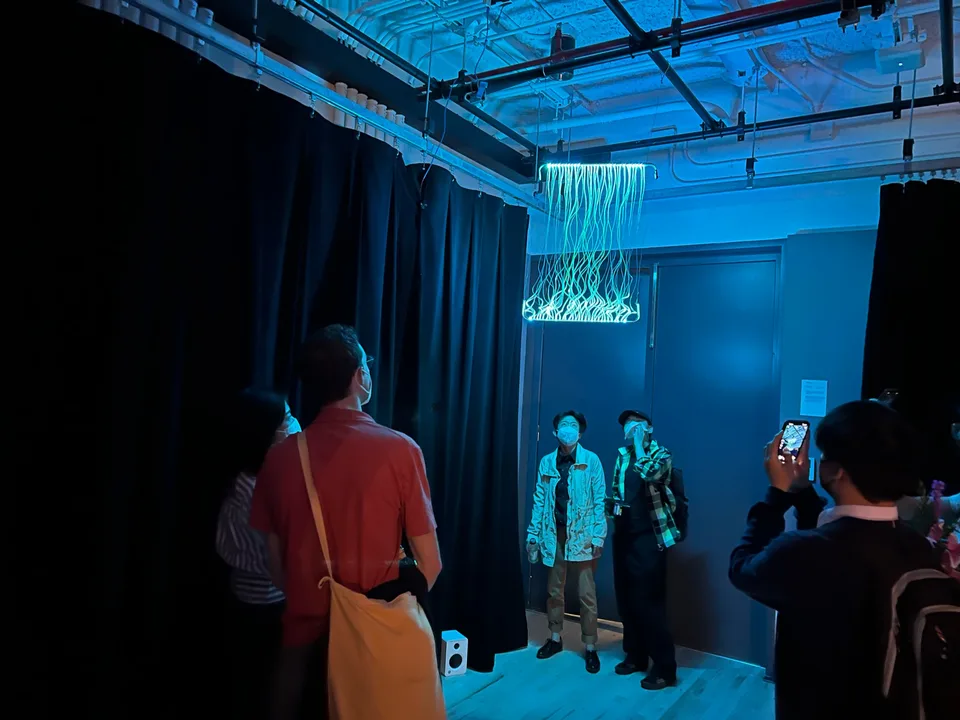
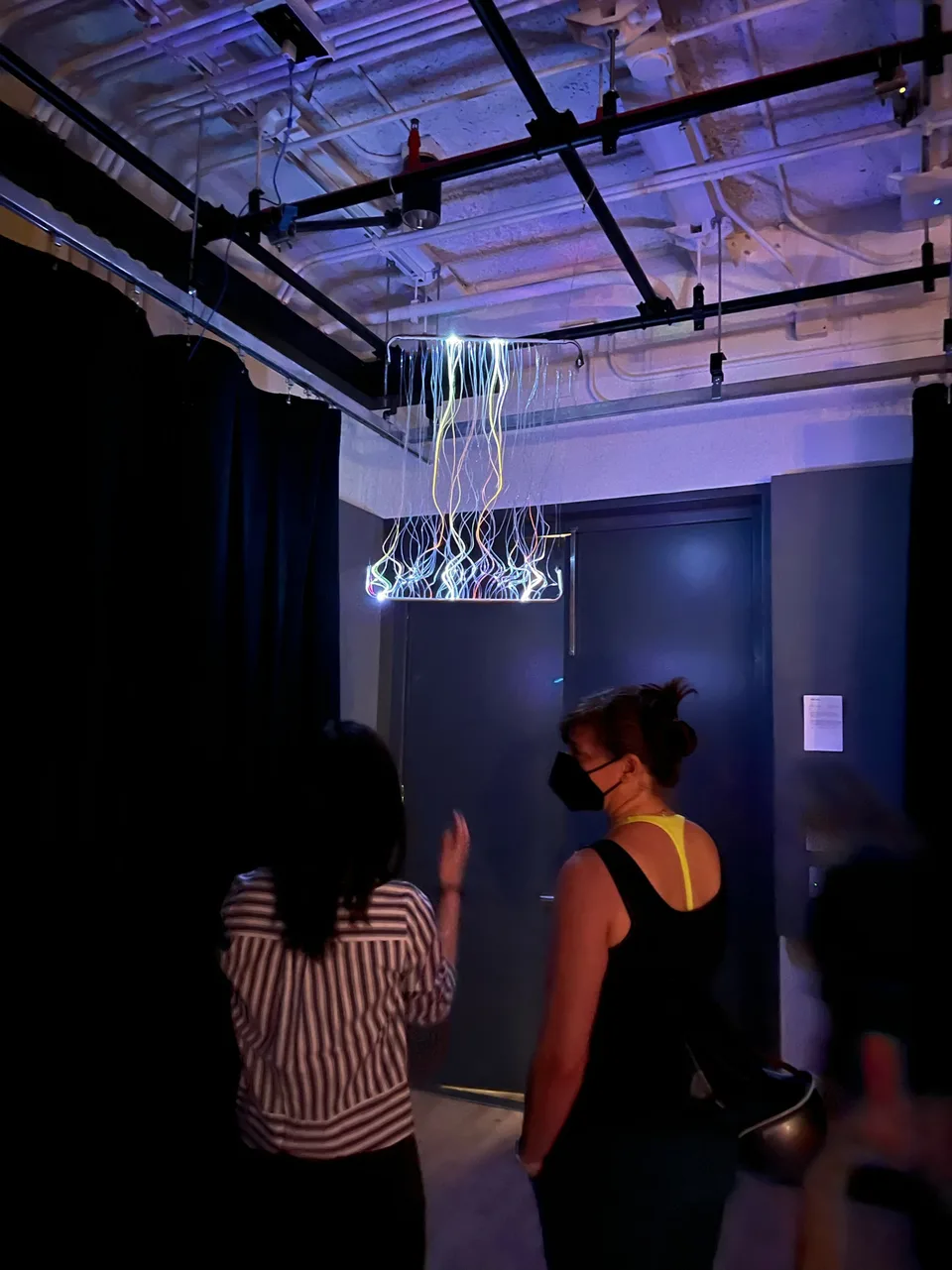
Light Wave was presented at the 2022 ITP Spring Show. I noticed that visitors were immediately intrigued by the changing light and sound. They wanted to know what the medium was made of, asked about the reasoning behind the project, and expressed amazement at the light patterns it generated.
These conversations brought both the sensory experience and the material construction into focus. Visitors’ questions also offered a way to examine how clearly the project communicated its connection to nature.
Critical reflection
What the exhibition revealed
The changing light and sound drew attention, and the unfamiliar medium prompted questions. Those observations suggest that the piece invited viewers to look more closely at its construction. The material itself became a point of curiosity within the encounter.
Visitors also asked why I had made the piece. That question is useful: the sensory qualities were immediately noticeable, while the underlying inquiry needed further conversation. Looking back, I would examine how to invite reflection on the artificial and the organic alongside curiosity about the medium. A short statement or an initial sketch could help open that discussion.
What I would examine next
The lightweight metal frame was a practical response to weight and time constraints. A next iteration would let me revisit that choice in relation to the floating-screen intention: how does the visibility of the frame affect the apparent lightness of the surface, and how could the support and thread connections be refined?
I would document the thread experiments more systematically, comparing the visible pattern, the connection to the LEDs, and the stability of the assembly. Showing those comparisons would make the reasons behind the material choices easier to understand.
I would also examine how the exhibition setting affects the experience. Ambient light, surrounding noise, and viewing distance all offer concrete variables to compare when presenting the piece again.
- How could the presentation invite reflection on the artificial and the organic while leaving room for personal interpretation?
- Which thread sizes and materials best balance the desired light pattern with a stable assembly?
- How does the balance of light and sound change across different viewing positions?
These questions connect the material investigation to the audience encounter and give a next iteration a clearer basis for evaluation.